What happened
Anthropic holds a $200 million contract with the Pentagon, signed last July. Claude is the only frontier AI model currently deployed on the military's classified networks — it was used in the operation to capture Nicolás Maduro, and by all accounts performs well enough that one defense official called the idea of removing it "a huge pain in the ass."
The Pentagon demanded that Anthropic remove all usage restrictions and allow Claude to be used for "any lawful purpose." Anthropic drew two lines: no mass domestic surveillance, and no fully autonomous weapons. On Thursday, CEO Dario Amodei published a statement. One sentence stands out:
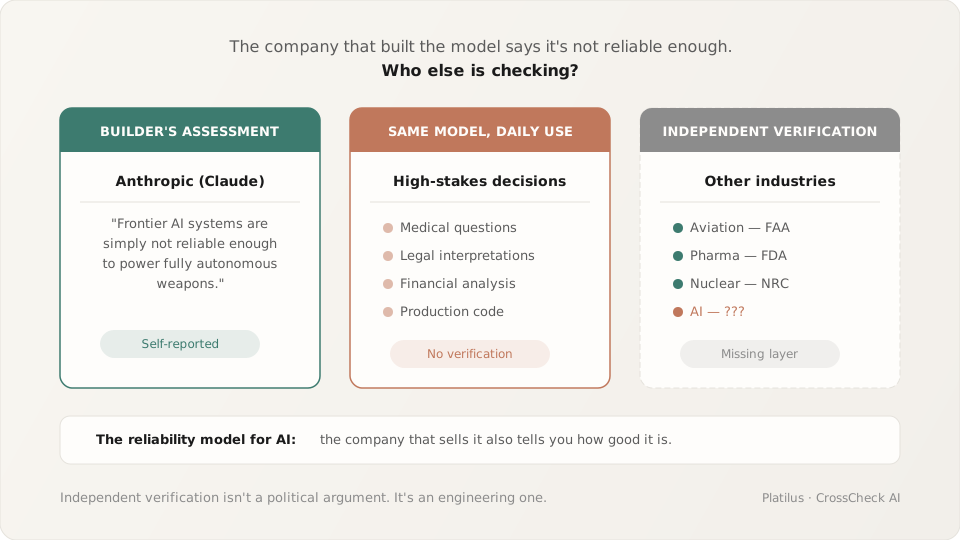
"Today, frontier AI systems are simply not reliable enough to power fully autonomous weapons."
On Friday, President Trump ordered every federal agency to stop using Anthropic's technology, and the Pentagon designated the company a "supply chain risk to national security" — a label previously reserved for foreign adversaries like Huawei. Anthropic said it will challenge the designation in court. OpenAI's Sam Altman told employees his company holds the same red lines, and hundreds of workers at Google and OpenAI signed open letters supporting Anthropic's position.
What everyone is focused on
The political drama — who's brave, who's not, who's switching AI subscriptions over it. Anthropic's stance deserves respect, because saying no to the Department of Defense while being threatened with the Defense Production Act is not a trivial decision. But the part worth paying attention to isn't the standoff itself.
The reliability claim
Anthropic didn't refuse on principle alone — they made a specific technical claim: their AI is not reliable enough for this application. This is the company that built the model, has seen the internal benchmarks, and understands the failure modes and edge cases better than anyone outside their research team. Their assessment is that Claude cannot be trusted to make autonomous life-or-death decisions.
That's a reasonable position on weapons. But the same model, with the same reliability profile, is making consequential decisions in other domains every day — medical questions that don't get a second check, legal interpretations that people act on, business analysis behind significant financial decisions, code that goes to production and handles user data.
The error rate doesn't change based on who's reading the output; LLMs generate text the same way whether the prompt comes from a military planner or a startup founder. Depending on the context, the gap between "military-grade consequences" and "civilian consequences" can be narrower than it seems.
The missing layer
The only thing that stood between unreliable AI and a high-stakes deployment was Anthropic saying no. There was no independent standard, no third-party verification, no technical audit involved in that decision — one company was willing to lose a government contract over it, and that was the entire safety mechanism.
xAI already signed an "all lawful purposes" contract for classified work this week, and the next company in a similar position may not take the same stance. In the thousands of quieter deployments across hospitals, courtrooms, and financial firms, nobody is even asking the reliability question publicly.
In aviation, we don't rely on Boeing's self-assessment that their planes are safe; in pharmaceuticals, the FDA verifies independently. In construction, nuclear energy, and food safety — wherever technology touches human lives — there's a verification layer built by someone other than the builder. AI doesn't have an equivalent for military use or otherwise, and the entire reliability model for the most widely deployed technology of this decade remains: the company that sells it also tells you how good it is.
What this points to
The Anthropic story will fade from the news cycle, but the structural gap it revealed won't close on its own. Independent verification of AI reliability — not self-reported benchmarks, not terms of service — is a missing piece in how we deploy these systems.
Something closer to what other engineering domains already have: assessment by people who didn't build the model and don't have a commercial interest in its adoption.
Not a political argument — an engineering one.
Notes
This article is part of our ongoing research into AI reliability and independent verification. We study how AI systems fail, where verification breaks down, and what it takes to build assessment that doesn't rely on trust alone.
Join the CrossCheck beta
First 100 users get free access. We'll share more research like this along the way.